
Acne
One of the most common dermatological conditions — it affects adolescents and adults, with very variable presentations and intensities. Most cases can be evaluated and guided online.
What is
Acne is a chronic inflammatory disease of the hair follicle — the structure of the skin that includes the hair and sebaceous gland that produces sebum. It manifests mainly on the face, but can also appear on the chest, back and shoulders.
It is one of the most common dermatological conditions: it affects most adolescents during puberty and persists or reappears in adulthood in many people — especially in women. The intensity varies between mild and occasional lesions and extensive cases with risk of permanent scarring.
Although common, acne is not a "smaller" problem: it has a known impact on self-esteem, sleep and social interactions. It is a medical condition that responds to treatment — the sooner it is assessed by a dermatologist, the lower the risk of lasting marks.
Signs and symptoms
The acne presents varied lesions, often coexisting in the same skin. Recognizing the type of injury helps the dermatologist decide the treatment plan.
- Open meats (black spots) — dilated pores with oxidized sebum.
- Closed edibles (white spots) — small white nodules or skin colour.
- Papules — small red and inflamed elevations, sensitive to touch.
- Pustules — lesions with purulent content ("classical bubbles").
- Nodules — deeper, more painful inflammatory lesions.
- Cystos — deep, painful nodules with a higher risk of scarring.
- Post-inflammatory stains — dark or reddish marks that remain after the injury disappears.
- Scars — permanent depressions or projections, more frequent in untreated cases.
Types of acne
The classification guides the treatment. These are the most common frames:
- Comedonic acne — black and white dots predominate, with little inflammation.
- Acne papulopustulous — combination of comedies, papules and pustules; the most frequent pattern.
- Nodulocystic acne — deep, painful lesions with a high risk of scarring.
- Hormonal acne — outbreaks aligned with the menstrual cycle, especially in the chin and jaw area.
- Late acne (adult) — it arises or persists after 25 years, more common in women.
- Mechanical acne — caused by friction or pressure (capacettes, masks, backpacks).
CAUSES AND RISK FACTORS
Acne results from the combination of several mechanisms that occur simultaneously in the hair follicle:
- Increased production of tallow, often stimulated by androgen hormones.
- Obstruction of the follicle by keratin, forming the comet.
- Colonization by bacteria (Cutibacterium acnes), which amplify inflammation.
- Local inflammatory response — which explains the papules, pustules and nodules.
In addition to these mechanisms, there are individual factors that increase the probability or intensity: family history, hormonal changes (puberty, polycystic ovarian syndrome, pregnancy), stress, some medicines (e.g. corticosteroids), commedogenic cosmetics, prolonged moisture and friction. Food — in particular dairy products and foods with a high glycaemic index — has a possible role in some cases, although it is typically secondary.
Diagnosis
The diagnosis is clinical — that is, made by the observation of the lesions and the patient's clinical history. No routine tests required.
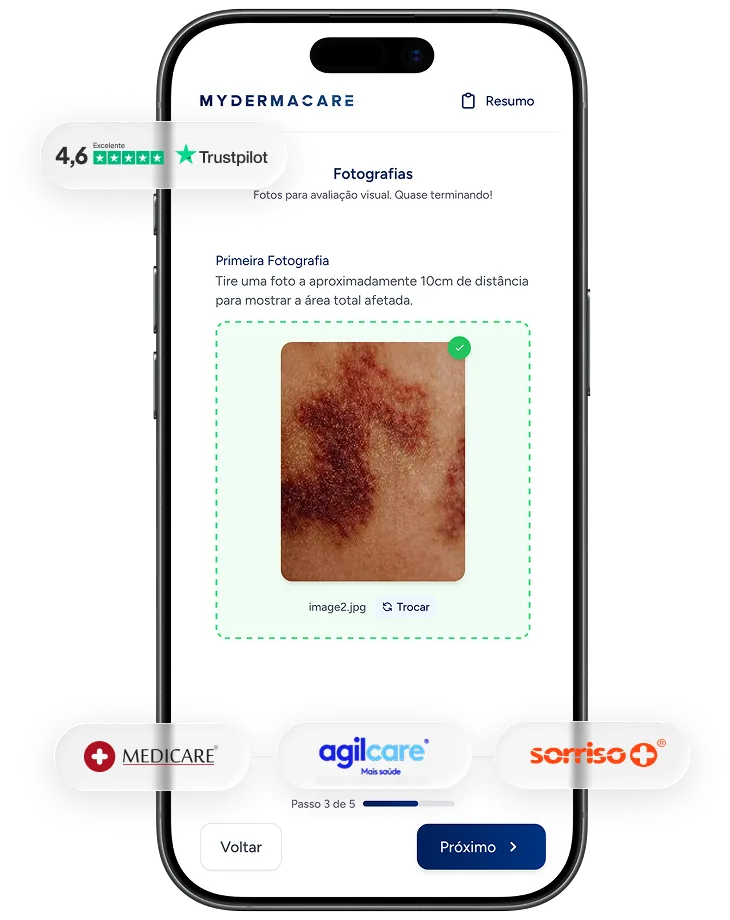
In an online consultation, the dermatologist analyzes 3 photographs of affected areas (at different angles, with good lighting) and a short questionnaire on the evolution of lesions, treatments already experienced, hormonal cycle (when applicable) and skin care habits. With this information it classifies the type and severity of acne and proposes a personalized treatment plan.
In particular situations — suspected endocrine cause, resistance to previous treatments, or associated signs outside the standard — the dermatologist may request additional tests or recommend a face - to - face assessment.
Talk to a dermatologist about your acne
No months-long wait for an in-person appointment. Each case reaches the dermatologist already prepared with photographs, history and questionnaire answers. Choose a report in under 24h or a booked video consultation.
Start consultationOptions for treatment
The treatment of acne is individual: it depends on the type of injury, severity, age, skin type and psychological impact. There are three major categories of intervention:
Topical treatment (applied on the skin)
Formulations applied directly in the affected areas. Often enough in mild to moderate conditions. The choice, combination and adjustments over time depend on the evaluation of the dermatologist and individual skin response.
systemic treatment
Indicated in moderate to severe conditions, when topical treatment is insufficient or there is a risk of scarring. The approach is defined case by case by dermatologist, with regular medical follow-up along the plan.
Adjuvant care
Suitable skin care routine, daily sun protection with non-comedogenic formulations, and — in specific cases — dermatological procedures to treat scars or residual stains after active acne is controlled.
It is important to know that the treatment takes time: the first results usually occur after 6-8 weeks and the condition may deteriorate transiently at the beginning. Adhering to the plan and maintaining follow-up with the dermatologist are the factors that most influence success.
Prevention
There is no guaranteed way to prevent acne — many factors are individual and hormonal. But there are habits that reduce the frequency and intensity of outbreaks, and that help to control the disease already installed:
- Smooth skin cleaning, twice a day, with non-abrasive product.
- Avoid comedogenic products — on the skin, on the hair (if it reaches the forehead) and makeup.
- Daily photoprotection with non-comedogenic formulations.
- Not squeezing or pinning the lesions — increases the risk of infection and scarring.
- Review the use of devices that make prolonged friction (cap, mask, handles).
- Seek assessment by a dermatologist as soon as the pictures gain persistence or intensity.
Home care and frequent myths
Some home care is useful; others — repeated in forums and social networks — have no evidence and can worsen the skin:
- Do not wash the skin with aggressive soaps or several times a day — the skin barrier deteriorates and inflammation worsens.
- Do not use alcohol, lemon, or toothpaste as a home remedy — they irritate and can stain.
- Tanning the skin does not treat acne — it temporarily maskes the lesions and increases the risk of post-inflammatory spots.
- Not all acne is "food"—food changes can help in some cases, but they rarely resolve on their own.
- Simple and consistent cosmetic routines work better than many products simultaneously.
Frequently asked questions
Is acne contagious?
Nope. The acne is not transmitted from person to person. It involves hormonal, inflammatory, and microbial mechanisms that occur within the hair follicle itself — it is not a transmissible infection.
How long does acne last?
Depends on the painting. Puberty acne can last several years, with gradual improvement. Adult acne may be intermittent or persist for a long time. Treatment controls the disease — the first results usually appear 6 to 8 weeks after starting.
Is the online dermatology consultation for acne?
Yeah. Acne is one of the conditions that is well assessed by photography and clinical questionnaire. The dermatologist classifies type and severity, proposes a personalized treatment plan, and follows evolution — all without leaving home.
Do I need a face-to-face appointment at some point?
Not always. Many cases are followed entirely online. If the dermatologist considers a face-to-face assessment necessary at a given time of the plan, indicate it in the report and direct the next step — in your district or outside of it.
Should I squeeze out the pimples?
Nope. Squeezing increases the risk of infection, prolongs inflammation and is the main cause of scars and post-inflammatory spots. If an injury requires physical intervention (e.g. a cyst), this intervention should be performed by a professional.
Does diet influence acne?
In some cases, yes — dairy products and foods of high glycaemic index (refined sugars, processed flours) have been associated with worsening in observational studies. But the weight of food varies widely among people; rarely does an isolated food intervention solve the situation.
Treat your acne with a dermatologist without waiting months
Clinical questionnaire, 3 photographs and a dermatologist responds within the chosen plan. No markings, no movement.
- From 60€
- Report on average within 24 working hours
- 100% refund if guidance is not possible