
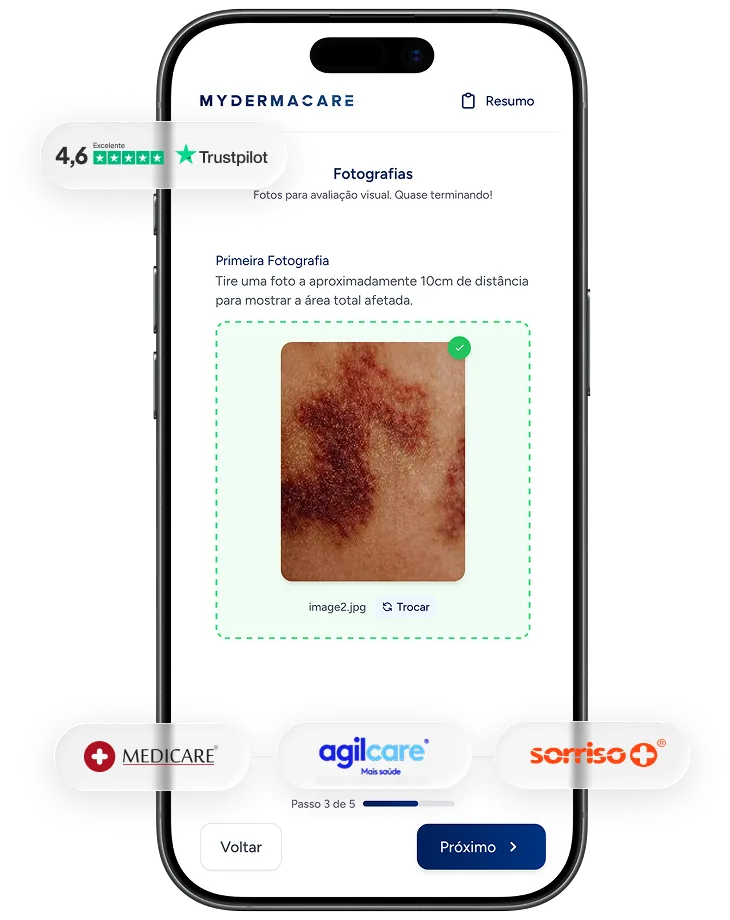
Skin allergies
Skin allergies manifest in many different ways — redness, itching, papules, eczemas. The assessment by a dermatologist helps to identify the trigger and guide the treatment.
What are skin allergies
Skin allergies are reactions of the immune system to substances that, in non-allergic people, are harmless. They can be local (at the point of contact) or systemic, acute or chronic — and manifest in very varied ways.
It is one of the most frequent reasons for consultation in dermatology. Targeted evaluation allows identifying the trigger — an essential step to prevent further outbreaks.
Common skin manifestations
- Itch — practically always present.
- Local or generalized redness.
- Papules or vesicles.
- Eczemas — scaly plaques.
- Urticaria — elusive papules with itching.
- Angioedema — deeper swelling, often on lips and eyelids.
- Fissures and lichenification in chronic forms.
Types of skin allergy
- Allergic contact dermatitis — reaction to allergen in direct contact.
- Urticaria — often with acute allergic component.
- Angioedema — deeper swelling, alone or associated with urticaria.
- Reaction to insect bites.
- Atopic dermatitis — chronic condition with allergic component in many patients.
- Drug reactions — usually with general skin involvement.
Frequent triggers
- Metals (nickel), cosmetics, fragrances, preservatives.
- Food in sensitive people.
- Medicines
- Bug bites, hymenoptera venom.
- Environmental allergens (acars, pollens, animal hair) — more often respiratory, but also skin.
- LATEX
Diagnosis
The diagnosis begins with a detailed clinical history — it is often the one that guides the most. In an online consultation, the dermatologist evaluates photographs of the lesions and a structured questionnaire on exposures, food, medicines and context.
In cases requiring further investigation, specific skin tests (epicut tests, prick tests) may be recommended — performed in person.
Talk to a dermatologist about your allergy
No months-long wait for an in-person appointment. Each case reaches the dermatologist already prepared with photographs, history and questionnaire answers. Choose a report in under 24h or a booked video consultation.
Start consultationOptions for treatment
Treatment always has two axes: identifying/avoiding the trigger and treating the lesions. Without the first, the second is just palliative.
Allergen avoidance
Key step. In contact allergies it is clear; in food or drug allergies, it requires targeted research. The dermatologist helps define the strategy.
Treatment of injuries
Formulations and plans defined case by case by dermatologist, depending on the type of allergy and intensity. Base for symptom control.
Investigation of causes
In recurrent cases, research with specific tests may be important — coordinated by the dermatologist, with face-to-face referral when necessary.
Frequently asked questions
How do I know if it's allergy or irritation?
You can't always tell by the look of it. Allergy involves immune sensitization and may arise even with small contacts; irritation depends on concentration and exposure time. Clinical evaluation and, if necessary, specific tests clarify.
Is online consultation for skin allergies?
Yeah. It is especially suitable for screening, initial evaluation and planning. In cases requiring epicutaneous tests or allergological evaluation, the dermatologist indicates the next step.
When should I seek urgency?
If there is difficulty breathing, swelling of the tongue/neck, dizziness or loss of consciousness — it may be an anaphylactic reaction, a medical emergency. In such cases, seek hospital emergency immediately.
Can allergies pass with age?
Some allergies — especially childhood food — can resolve spontaneously. Contact awareness in adults is usually permanent.
Investigate your skin allergy
Send photos and a detailed questionnaire. A dermatologist helps identify the trigger and define the plan.
- From 60€
- Report on average within 24 working hours
- Targeted research