
Scars
Natural result of skin healing. There are several types, with different approaches. The assessment by a dermatologist allows choosing the appropriate strategy.
What are scars
Scarring is the natural result of the healing process of the skin after an injury — surgery, wound, acne, burn, or any trauma involving the dermis. Each person heals differently, and the same person may have very distinct scars depending on the location and nature of the original injury.
The assessment by a dermatologist allows identifying the type of scar and defining the best strategy — from initial care to optimize healing to specific treatments to improve the appearance of scars already formed.
Types of scars
- Normal scars (plans) — the expected result; discreet, with good evolution.
- Hypertrophic scars — high, reddish, within the limits of the original lesion.
- Cheloids — high, reddish, exceed the limits of the original lesion; individual predisposition.
- Atrophic scars — depressed in relation to the skin; common after acne.
- Acne scars — atrophic (ice-pick, boxing, rolling) or hypertrophic.
- Hyperpigmented scars — with altered residual pigmentation.
Diagnosis
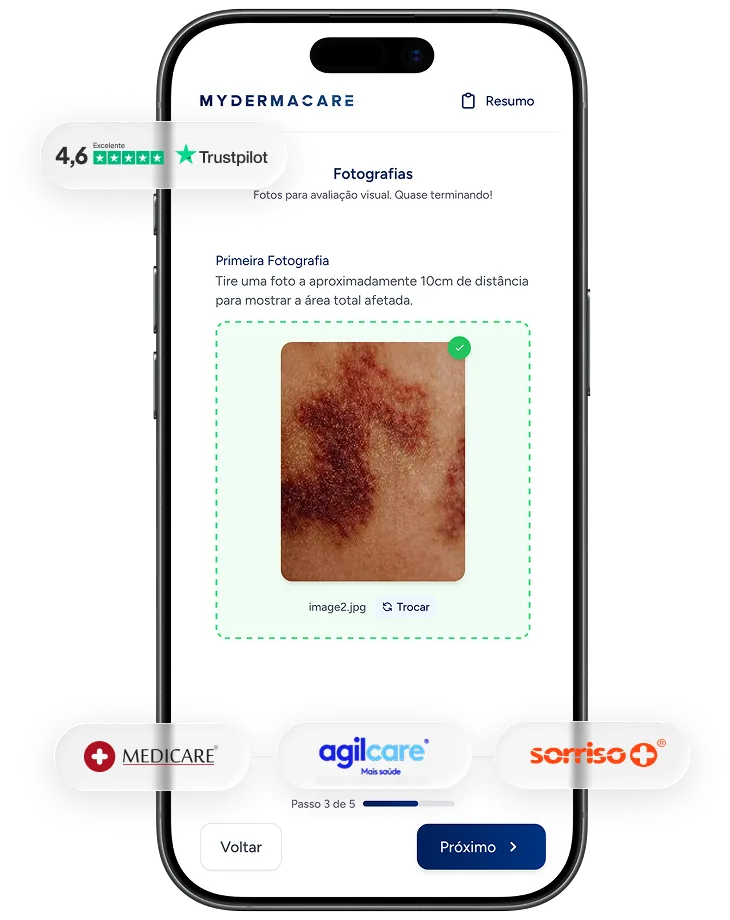
The diagnosis is clinical. In an online consultation, the dermatologist evaluates photographs of scars in good lighting and a questionnaire on origin, evolution and other treatments already tried.
Options for treatment
Treatment depends on the type of scar, evolution time, location and expectations. Recent scars respond better — early intervention is important.
Care in the first weeks
In recent scars (up to 6-12 months), optimization measures — massage, hydration, silicone, rigorous sun protection — make a big difference. Defined by the dermatologist.
Topical application
There are formulations that can improve the appearance of scars already formed. They are indicated by the dermatologist according to type.
In-office procedures
Several procedures can improve scarring — from laser infiltrations, depending on the type. Individually evaluated in face-to-face consultation.
Prevention
- Taking care of the original wound — prevents infection and reduces the risk of poor healing.
- Strict sun protection on recent scars — prevents hyperpigmentation.
- Massage and hydration after initial healing.
- Avoid scar tension in the first few weeks.
- To evaluate early scars that become elevated or pruritic.
- If you have a tendency to keloid, inform any surgeon to minimize risk.
Talk to a dermatologist about your scars.
No months-long wait for an in-person appointment. Each case reaches the dermatologist already prepared with photographs, history and questionnaire answers. Choose a report in under 24h or a booked video consultation.
Start consultationFrequently asked questions
The scars disappear completely?
Nope. Once a scar is formed, it can be greatly attenuated but rarely disappears completely. Recent scars respond better — hence the importance of acting early.
How long does it take a scar to stabilize?
Usually 6-12 months for most of the evolution. Recent scars may turn red or high in this period — it does not mean a problem; part of normal evolution.
Is online consultation for scars?
Yeah, for evaluation and planning. Many treatments are procedures in face - to - face consultation — the dermatologist guides the next step if applicable.
The keloids come back after treaties?
They can come back — individual predisposition remains. Therefore, treatment requires continued strategy and follow-up, especially in people with a known trend.
Improve the appearance of your scars
Send photographs in good lighting. A dermatologist evaluates and proposes the plan.
- From 60€
- Personalized Plan
- No travel