
Contact dermatitis
Inflammatory skin reaction by contact with a substance — irritant or allergic. Identifying and avoiding the responsible agent is the essential step.
What is contact dermatitis
Contact dermatitis is an inflammatory reaction of the skin triggered by contact with a substance — it may be an irritant (direct and immediate effect) or an allergen (immune reaction after prior sensitization).
It is extremely common — it is among the most frequent dermatological consultations. The treatment of lesions is usually effective, but the decisive step is to identify and avoid the responsible agent to avoid recurrence.
Types
- Irritative dermatitis — the most common; results from direct damage of the skin barrier by the substance. It can occur at first exposure, and the intensity depends on the concentration and contact time.
- Allergic dermatitis — acquired immune reaction after prior sensitization. It requires prior contact with the substance and may appear even at very low concentrations.
Signs and symptoms
- Well-defined redness, often in the shape of the contact area.
- Itch — often the most disturbing symptom.
- Small blisters or blisters in more intense pictures.
- Flaking and burning.
- In chronic forms — thickening and lichenification of the skin.
- Location — depends on the agent and contact (hands are very frequent, but can appear anywhere).
Common causes:
- Detergents, bleach and cleaning products (hands).
- Cosmetics, perfumes and preservatives.
- Metals — mainly nickel (bijute, buttons, coins).
- LATEX
- Plants — poison ivy, some ornamental plants.
- Hair products (hair, forehead, ears).
- Stickers, gloves, dressings.
- Fragrances in apparently inert products.
Diagnosis
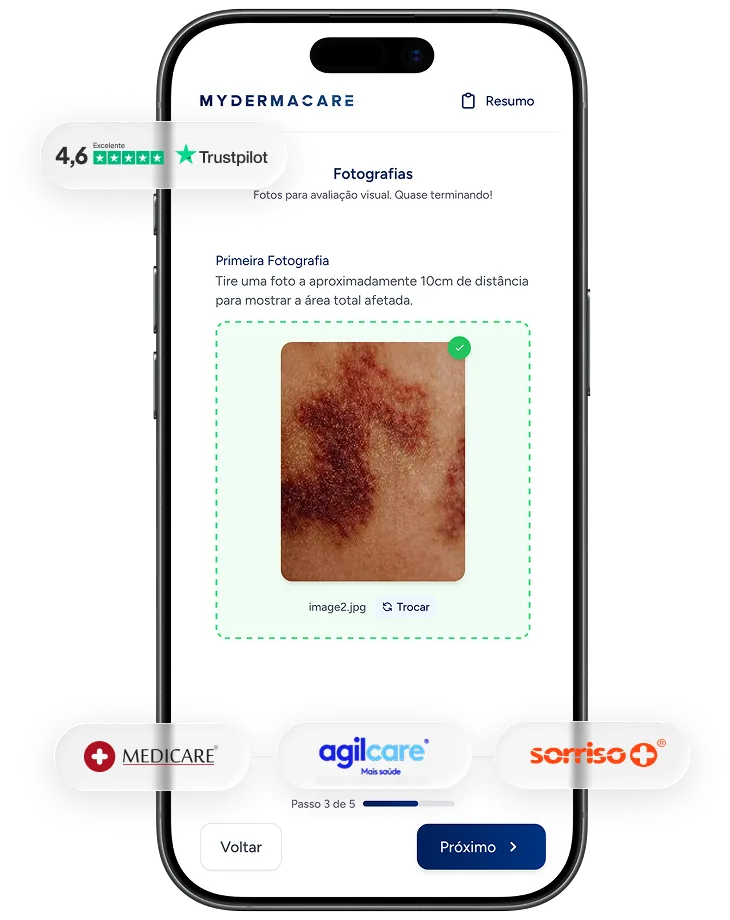
The diagnosis is clinical — by the distribution and history of exposure. In an online consultation, the dermatologist evaluates photographs of affected areas and a detailed questionnaire on activities, products, recent exhibitions and evolution.
In chronic cases or without clear cause, the dermatologist may recommend epicutaneous tests (patch tests) — performed in person — to identify specific allergens.
Talk to a dermatologist about your contact dermatitis
No months-long wait for an in-person appointment. Each case reaches the dermatologist already prepared with photographs, history and questionnaire answers. Choose a report in under 24h or a booked video consultation.
Start consultationOptions for treatment
Treatment is based on three axes: identify and avoid the agent, treat the lesions and restore the skin barrier.
Identify and avoid
More important and decisive step. Without eliminating contact, treatment is always incomplete. The dermatologist helps to research the responsible agent and organize practical avoidance.
Topical treatment OF lesions
Formulations applied in affected areas to control inflammation and itching. Defined by the dermatologist according to intensity.
Skin barrier restoration
Generous daily hydration, gentle baths, avoidance of aggressive soaps — essential for recovery and prevention of new outbreaks.
Frequently asked questions
Do I need to run allergy tests?
Not always. If the trigger is evident by history (e.g. a new jewel), it is not necessary. In chronic cases or with no clear cause, epicutaneous tests can be very useful — the dermatologist indicates when they make sense.
Once you're touched, is it forever?
Usually yes — sensitization to an allergen is usually permanent. That's why identification is so important: so you can avoid it all your life.
Is online consultation for contact dermatitis?
Yeah, for most cases. The pattern of injuries and history guide the diagnosis. If epicutaneous tests are necessary, the dermatologist indicates and guides the next step.
If you remove the product, how long will it take?
The lesions usually improve within 1-3 weeks after the evacuation. Chronic forms may take longer — especially if the skin barrier has been badly damaged.
Identify the trigger for your contact dermatitis
Send photographs of affected areas and answer the questionnaire. A dermatologist analyzes the case and helps identify the agent responsible.
- From 60€
- Report on average within 24 working hours
- Targeted research