
Scabies
Skin infestation by a small mite (Sarcoptes scabiei), highly contagious. The intense itching, especially at night, is the most characteristic sign.
What is Scabies
Scabies — commonly known as mange — is an infestation of the skin caused by the Sarcoptes scabiei mite. The mite female digs tunnels in the surface layer of the skin, where she lays eggs. The immune reaction of the organism is responsible for the characteristic intense itching.
It is a highly contagious condition and has had an increase in cases in recent years. It is effective with a systematic approach — including simultaneous treatment of close contacts and care with linen and linen.
Signs and symptoms
- Intense itch, typically worse at night — the most characteristic symptom.
- Small serpiginous lines on the skin (tunnels) — often hard to see.
- Papules and abrasions caused by the act of scratching.
- Typical locations — spaces between fingers, wrists, elbows, armpits, waist, genital region, nipples, buttocks.
- In babies — also scalp, palms and soles of the feet.
- There may be eczematization and secondary bacterial infection.
- Itch from others — a frequent and suggestive sign.
contagion
Escabio is transmitted mainly by close and prolonged direct contact (intimate contacts, patient care, cohabitation). Shared objects (clothes, sheets, towels) can also transmit, although less frequently.
The incubation period until the onset of symptoms can go up to 4-6 weeks in the first infection — often the patient has infected others before he knows he has scabies.
Diagnosis
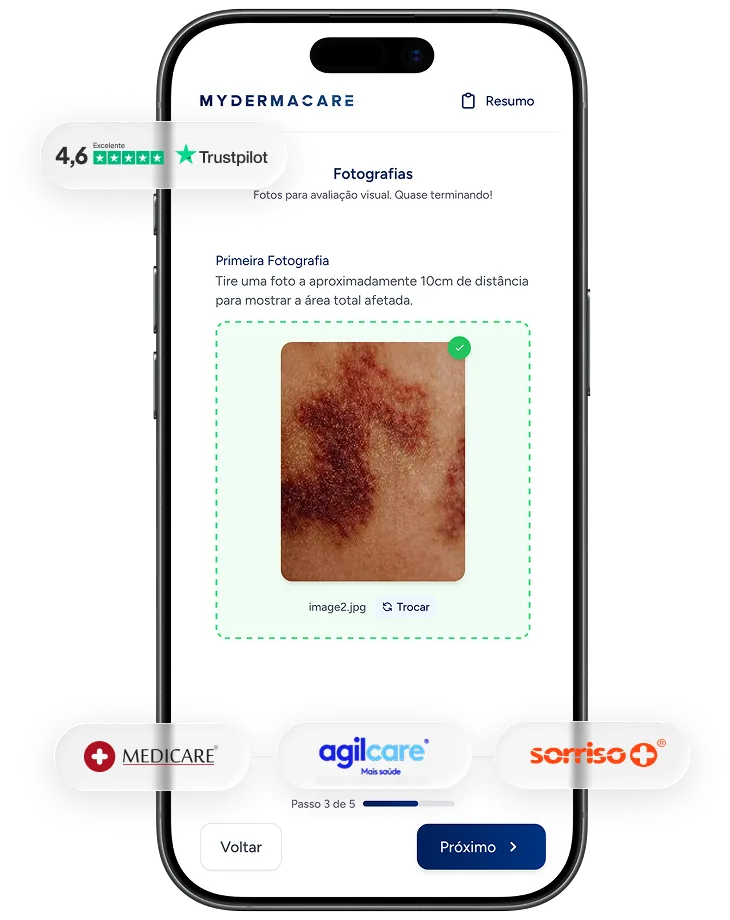
The diagnosis is clinical — by the typical distribution, characteristic itch and frequent epidemiological context (more than one case in the family or in the nearby environment). In an online consultation, the dermatologist evaluates photographs and a detailed questionnaire on pattern, contacts and evolution.
In doubtful cases direct examination of the mite by dermatoscopy — performed in person, may be recommended.
Options for treatment
Treatment must be systematic to be effective. In addition to the patient, all close cohabitants should be treated simultaneously, even asymptomatic ones — to avoid chain re-infection.
Topical or systemic treatment
There are effective treatment options that are defined by the dermatologist as appropriate. Strictly fulfilling the instructions (application, time, repetition) is essential.
Decontamination of clothing and environment
Wash laundry, sheets and towels at high temperature (60°C) or put in closed bag for several hours or days to eliminate mites. Aspirate sofas, carpets and mattresses.
Treatment of cohabitants
All close contacts must be dealt with simultaneously. Without this step, escabiosis returns quickly.
Talk to a dermatologist about scabiosis
No months-long wait for an in-person appointment. Each case reaches the dermatologist already prepared with photographs, history and questionnaire answers. Choose a report in under 24h or a booked video consultation.
Start consultationFrequently asked questions
Does the itch pass when I start treatment?
It usually improves, but may persist 2-4 weeks after effective treatment. This is because the immune reaction to dead mites continues for some time. It doesn't mean treatment failure.
Does the whole family have to be treated?
All close companions should be treated simultaneously, even without symptoms. It is the step that most often fails and leads to re-infestation.
Is online consultation for scabiosis?
Yeah. By default and history it is often possible to diagnose by online consultation. The dermatologist defines the plan and coordinates family treatment.
If the dermatologist considers it clinically justified, is prescription issued?
Yeah. When the dermatologist considers clinically justified in the context of his case, electronic prescription may be issued together with the report. The decision to prescribe depends on the clinical evaluation.
Treat escabiosis systematically
Send photos and answer the questionnaire. A dermatologist defines the plan — for himself and for the living.
- From 60€
- Quick diagnostic:
- Family plan