
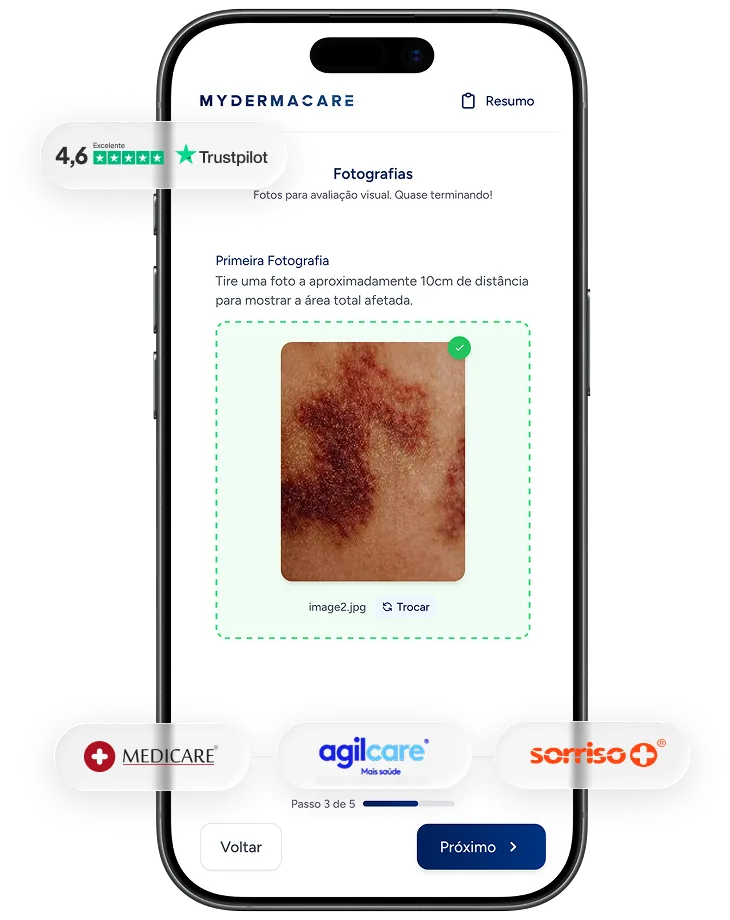
Haemangioma
Benign tumor of vascular origin, very common in babies. Most develop spontaneously, but some benefit from dermatologist evaluation and surveillance.
What is a haemangioma
A haemangioma is a benign tumor formed by a proliferation of blood vessels. It is one of the most common benign tumours in babies — infantile haemangioma appears in the first weeks of life, grows for a few months and then begins a spontaneous regression phase that lasts for years.
There are also hemangiomas in adults, with different evolution and behaviour. The assessment by a dermatologist allows identifying the type, deciding the strategy (surveillance vs intervention) and detecting early situations that need treatment.
Appearance
- Red or red coloring, with superficial brightness.
- Skin lift, soft consistency.
- Variable size — from millimeters to several centimeters.
- Typical locations — face, scalp, trunk.
- In babies — fast growth in the first months of life, then stabilization and regression.
- In adults — usually stable, more common in the trunk (ruby hemangiomas).
Most common types
- Infant haemangioma — the most common in babies; typical cycle of growth and regression.
- Congenital haemangioma — present at birth; behaviour different from that of children.
- Adult hemangiomas (ruby, cherry) — small benign red dots, very common after 30 years.
- Vascular malformations — not true hemangiomas, with distinct behaviour.
Diagnosis
The diagnosis is clinical. In an online consultation, the dermatologist evaluates photographs at different angles and a questionnaire about age, evolution (growth/stability), location and associated symptoms.
In infant hemangiomas with critical locations (close to the eye, mouth, airway, or very extensive) or with rapid growth, the dermatologist may indicate urgent face-to-face evaluation and possible complementary tests.
Therapeutic approach
Expectant surveillance
Many small child hemangiomas with no critical location are accompanied only by vigilance. In adults, small ruby hemangiomas are benign and do not require treatment.
Early treatment in selected cases
Some infantile hemangiomas benefit from early treatment — especially when they are at risk or rapidly growing. Set case by case by dermatologist, with close follow-up.
Procedures after regression
If after regression residual tissue persists with aesthetic impact, there are options in face consultation to improve appearance.
Talk to a dermatologist about haemangioma
No months-long wait for an in-person appointment. Each case reaches the dermatologist already prepared with photographs, history and questionnaire answers. Choose a report in under 24h or a booked video consultation.
Start consultationFrequently asked questions
Is my baby's haemangioma dangerous?
Most infantile hemangiomas are benign and return spontaneously. The ones that cause concern are those with rapid growth, with critical locations or with signs of complications — in these cases urgent assessment by a dermatologist is important.
Will you disappear on your own?
Child hemangiomas typically regress over several years — most significantly reduce to 5-7 years. It can leave a small residual mark in some cases.
Is online consultation for haemangioma?
Yeah, for initial evaluation and planning. Due to the aspect and evolution reported, the dermatologist can often confirm the diagnosis. In cases that require early treatment or close surveillance, guide the next step.
Are ruby hemangiomas in adults cancer?
Nope. Rubi hemangiomas (cherries) are benign, very common after 30 years and have no risk. They can be removed for aesthetic reasons in face consultation.
Evaluate a haemangioma with a dermatologist
Send photos and answer the questionnaire. A dermatologist evaluates the case and proposes the best approach — on average 24 hours useful.
- From 60€
- Ideal for pediatrics
- No travel