
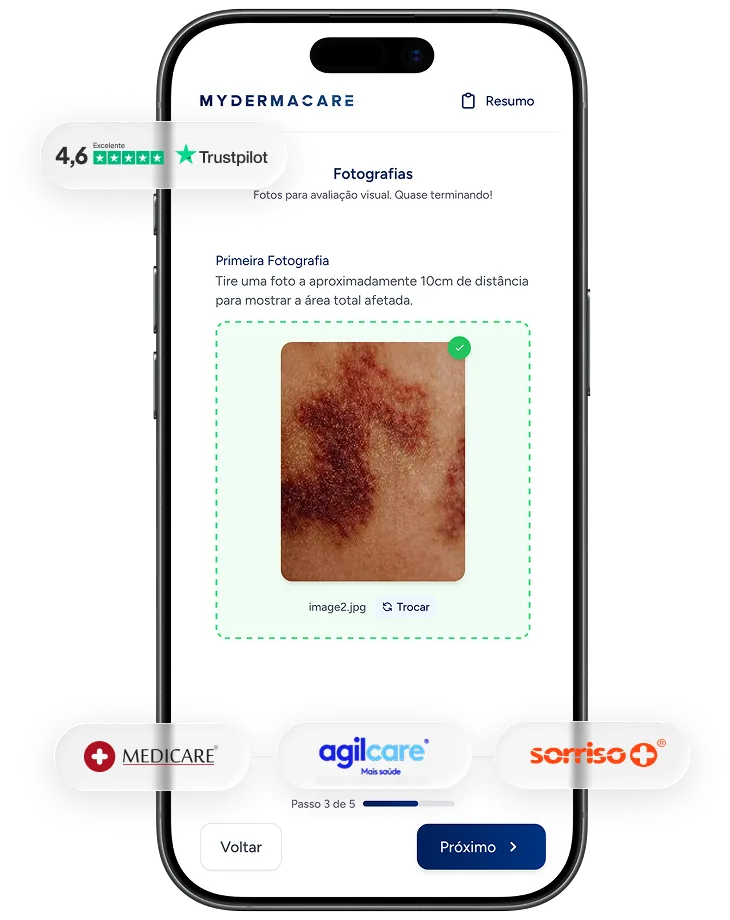
Shingles (herpes zoster)
Reactivation of varicella virus with vesicles grouped in a band in a body area — usually with severe pain. Early diagnosis and treatment make a difference.
What is herpes zoster
Herpes zoster — commonly called "zone" — is a reactivation of varicella-zoster virus that remained latent in nerve endings after a previous infection. It is manifested by vesicles grouped in range, following the territory of a specific nerve, and usually with intense pain.
It is more frequent after 50 years in situations of stress, immunosuppression or concomitant diseases. Vaccine is available from a given age — information to be discussed with the treating physician.
Signs and symptoms
- Pain, burning or tingling in a skin band before the appearance of lesions (prodromic phase).
- Vesicles grouped in bunch, on reddish base, with distribution in range (dermatome).
- Typical unilateral distribution — on one side of the body, without crossing the midline.
- More frequent locations — trunk (thoracic), face (including eye), neck.
- The gallbladders break and form crusts in 7-10 days.
- Pain may be intense and may persist during or after the outbreak.
Diagnosis
The diagnosis is clinical — the unilateral distribution with grouped vesicles is highly characteristic. In an online consultation, the dermatologist evaluates photographs of the lesions and a questionnaire about onset of symptoms, pain and location.
In cases with facial involvement close to the eye (ophthalmic herpes zoster) or with atypical lesions, diagnosis and guidance require urgent face-to-face assessment — by eye risk or by the need for additional tests.
Options for treatment
Treatment is more effective when initiated within 72 hours of the appearance of the lesions — it reduces the duration, intensity and risk of complications.
Early systemic treatment
In the cases indicated, there is systemic treatment that should be initiated as soon as possible. Defined by the dermatologist after evaluation of the case.
pain management
Herpes zoster pain can be intense and requires a specific approach. It is evaluated by the dermatologist and adjusted according to the response.
Local care
Keep lesions clean and dry, do not pierce gallbladders, cover exposed areas. Avoid contact with people who have never had chickenpox or have been vaccinated, pregnant and immunocompromised.
Complications to know
- Post-herpetic neuralgia — pain that persists after lesion resolution; more common in older people.
- Ophthalmic involvement — vesicles in the face involving the eye require urgent ophthalmological evaluation.
- Hearing involvement — herpes zoster oticus (Ramsay Hunt syndrome).
- Extensive cases in immunocompromised patients — may require hospitalization.
Talk to a dermatologist about your herpes zoster
No months-long wait for an in-person appointment. Each case reaches the dermatologist already prepared with photographs, history and questionnaire answers. Choose a report in under 24h or a booked video consultation.
Start consultationFrequently asked questions
Is it contagious?
The gallbladders contain viruses. Contacts that have never had chickenpox or have been vaccinated may contract chickenpox (non-zoster) by direct contact with the lesions. Avoid contact with vulnerable people until all lesions form crust.
Can you come back?
Yes, although it's less frequent. There is also a vaccine available to reduce this risk — information to be discussed with the treating physician.
Is online consultation for herpes zoster?
Yes, in most cases with typical distribution and no ocular involvement. It is important to contact quickly — treatment is more effective in the first 72 hours. In ophthalmic cases, seek urgent face-to-face care.
If the dermatologist considers it clinically justified, is prescription issued?
Yeah. When the dermatologist considers clinically justified in the context of his case, electronic prescription may be issued together with the report. The decision to prescribe depends on the clinical evaluation.
Evaluate herpes zoster in the first few hours
Send pictures of the injuries as soon as they appear. In the first days the treatment is more effective — online consultation enables rapid response.
- From 60€
- Early response
- No travel