
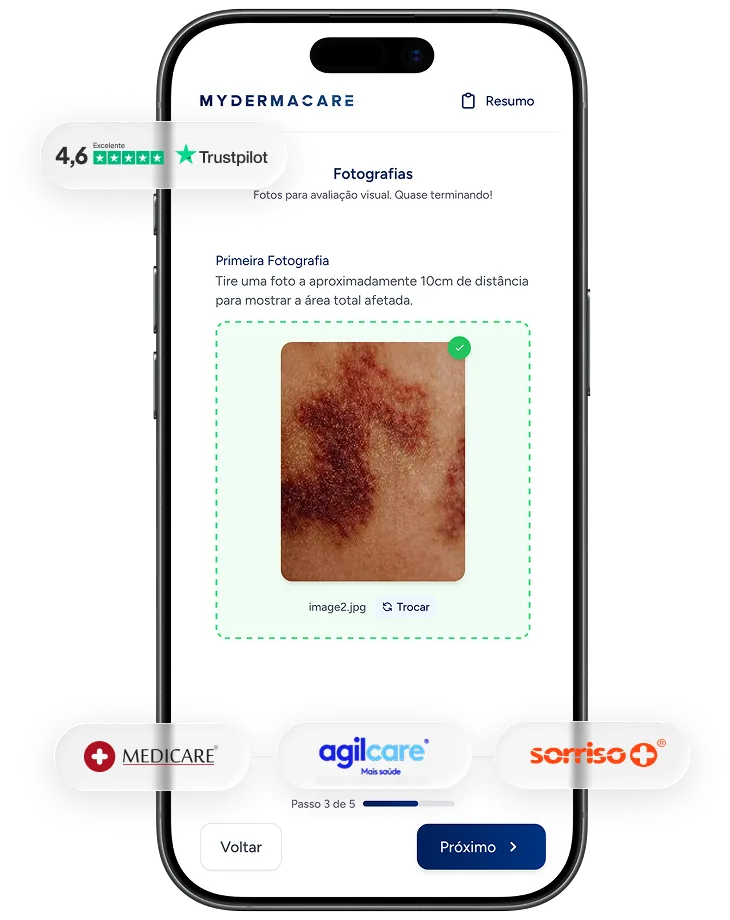
Post-inflammatory hyperpigmentation
Dark spots that remain after inflammation or skin damage — typical after acne. More frequent and persistent in darker phototypes.
What is post-inflammatory hyperpigmentation
Post-inflammatory hyperpigmentation (PHI) is a skin colour disorder that arises after an inflammatory process or injury. Very common after acne, but also after eczemas, folliculitis, injuries, procedures or burns.
It is a natural skin response — inflammation stimulates melanin production. It is more frequent and more persistent in darker phototypes. The whitening is gradual over months and can be accelerated with an appropriate approach.
Appearance
- Flat spots, darker than the surrounding skin.
- Variable colour — brownish, grey or black depending on the phototype.
- Locations — always correspond to the area of previous inflammation.
- Irregular contours, following the pattern of the original lesions.
- No peeling, itching or burning (the active phase is over).
- Slow evolution — it can take months to years to completely disappear.
Common causes:
- Acne — the most frequent cause of facial PIH.
- FOLLICULITIS
- Eczemas (atopic dermatitis, contact dermatitis).
- Trauma, burns, bites.
- Dermatological procedures (peelings, lasers).
- Allergic reactions
- Solar exposure of healing zones — aggravates and prolongs the stain.
Diagnosis
The diagnosis is clinical. In an online consultation, the dermatologist evaluates photographs in good lighting and a questionnaire about the original lesion, evolution of the stain and treatments already used. Distinguish PIH from other similar conditions (melasma, pigmented scars).
Options for treatment
The treatment is based on three axes: control any inflammation still present, lighten the existing spots and prevent new spots with strict sun protection.
Sun Shield
Rigorous and daily, with a high factor. Without this base, the other treatments are much less effective. Colored photoprotectors also protect from visible light — important in darker phototypes.
Topical application
Formulations that accelerate whitening, indicated by the dermatologist. They require continued use for months.
In-office procedures
In selected cases, dermatological procedures can accelerate. Evaluated individually after active phase control.
Talk to a dermatologist about hyperpigmentation
No months-long wait for an in-person appointment. Each case reaches the dermatologist already prepared with photographs, history and questionnaire answers. Choose a report in under 24h or a booked video consultation.
Start consultationPrevention
- Treat the underlying inflammatory condition early (acne, eczema).
- Not scratch, not squeeze, not interfere with inflammatory injuries.
- Strict sun protection in healing zones.
- Avoid cosmetic or aggressive procedures in the acute phase.
- Gently care for the skin during the healing process.
Frequently asked questions
How long does it take?
Months to years, depending on the depth of the initial inflammation, phototype and care. Darker photos tend to have more persistent PIH. Proper treatment speeds up significantly.
Is it different from scarring?
Yeah. PIH is a change of colour only, with normal relief skin. The scar involves alteration of the structure (depressed or elevated). They can coexist.
Is the online consultation for hyperpigmentation?
Yeah. The dermatologist distinguishes the different causes of hyperpigmentation (PIH, melasma) and defines the plan — very compatible with online consultation.
Can I go to the beach with PIH?
Yes, but with strict protection in the affected areas — high factor photoprotector, reapplied frequently, and ideally physical cover (clothes). The sun prolongs the stain a lot.
Clear the stains with a dermatologist
Send photographs in good lighting. A dermatologist defines the plan — an average of 24 hours useful.
- From 60€
- Personalized Plan
- Ongoing follow-up