
Impetigo
Skin superficial bacterial infection very common in children. Recognized by the characteristic honey-colored crusts. This is a good approach.
What is impetigo
Impetigo is a superficial bacterial infection of the skin, very common in preschool and school-aged children. It is caused mainly by Staphylococcus aureus and Streptococcus pyogenes.
It is recognized by the typical honey-colored crusts ("melicarericas") that form on initially vesicular lesions. It is good, but it is highly contagious — early treatment and hygiene measures are important to contain infection.
Signs and symptoms
- Red spots that quickly form small blisters or blisters.
- The vesicles break and form crusts of yellowish colour ("melon colour") — the most characteristic sign.
- Typical locations — face (around the nose and mouth), extremities, areas of minor trauma.
- It can cause itching; usually without significant pain.
- It can spread through the patient himself when it scratches.
- In cases with larger bubbles (bubbley) bubbles may be evident.
contagion
The impetigo is highly contagious, by direct contact with the lesions or contaminated objects (towels, clothes, toys). It spreads easily in families, kindergartens and schools.
The child being treated may usually return to school 24 hours after the initiation of appropriate treatment, provided that the lesions can be covered.
Diagnosis
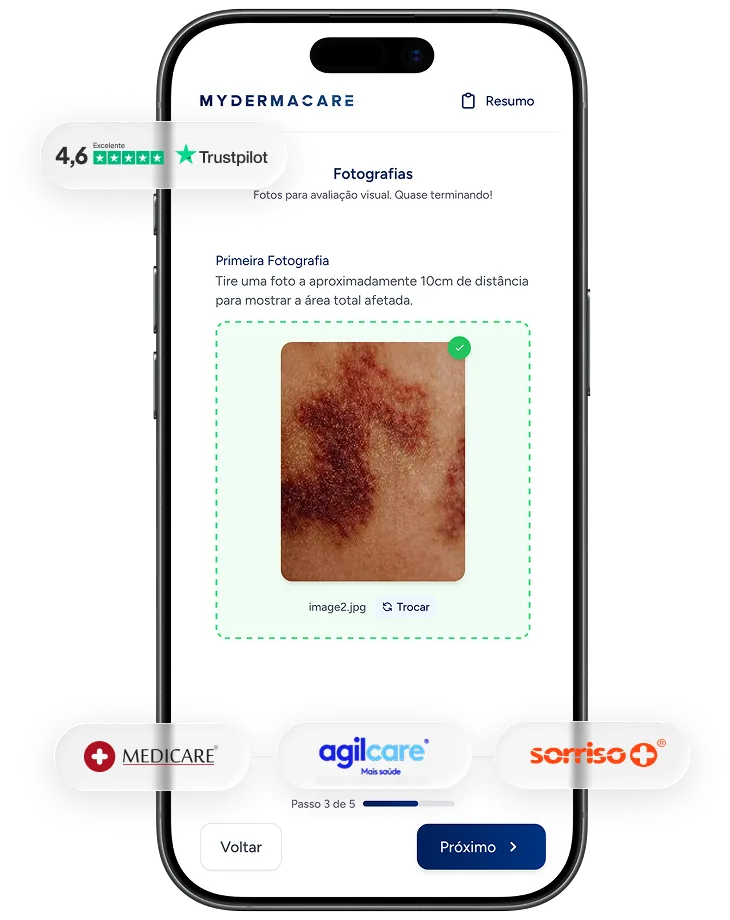
The diagnosis is clinical — the appearance is characteristic. In an online consultation, the dermatologist evaluates photographs of the lesions and a questionnaire on evolution, number of contacts and associated symptoms. In severe or atypical cases, bacteriological examination and face-to-face evaluation may be necessary.
Options for treatment
The impetigo responds well to appropriate treatment. The approach depends on the extent and general state of the patient.
Topical application
In limited lesions without general symptoms, local treatment is usually sufficient. It is indicated by the dermatologist and requires careful application after cleaning the area.
systemic treatment
Reserved for extensive cases, with widespread involvement, or in patients with risk factors. Defined by the dermatologist.
Hygiene measures
Frequent hand washing, short nails, separate sheets/towels, covering injuries — essential steps to avoid self-contamination and transmission to third parties.
Talk to a dermatologist about the impetigo
No months-long wait for an in-person appointment. Each case reaches the dermatologist already prepared with photographs, history and questionnaire answers. Choose a report in under 24h or a booked video consultation.
Start consultationFrequently asked questions
Can you come back after being treated?
Yes, you can resort, especially in children with nasal carriers of Staphylococcus. If recurrences are frequent, the dermatologist may guide specific measures.
Can the child go to school?
You can usually return 24 hours after starting treatment, provided the lesions can be covered. Always check with the dermatologist or pediatrician.
Is online consultation for impetigo?
Yeah. Because of the characteristic aspect the diagnosis is often possible by photography. The dermatologist defines the plan and indicates whether it justifies face-to-face evaluation.
If the dermatologist considers it clinically justified, is prescription issued?
Yeah. When the dermatologist considers clinically justified in the context of his case, electronic prescription may be issued together with the report. The decision to prescribe depends on the clinical evaluation.
Treat impetigo quickly
Send pictures of the injuries. A dermatologist evaluates and sends a treatment plan — an average of 24 hours.
- From 60€
- Ideal for pediatrics
- No travel