
Pityriasis versicolor
superficial fungal infection caused by the fungus Malassezia. It is manifested by lighter or darker spots on the trunk. Common in hot and humid climates.
What is pityriasis versicolor
Pitiriasis versicolor is a superficial fungal infection of the skin caused by the fungus Malassezia — a normal skin inhabitant that can proliferate under certain conditions. It is manifested by spots with altered pigmentation, typically in the trunk.
It is common in young adults and in warm and humid climates. It is not considered contagious (at least not in classical form) and responds well to appropriate treatment — but tends to resort.
Signs and symptoms
- Irregular, rounded or coalescent spots.
- Variable colour ("versicolor") — lighter than skin in tanned people; darker in light skin.
- Surface with thin peeling, evident when gently scraping.
- Typical locations — trunk, shoulders, neck, arms.
- Usually without significant itching; some people notice mild itching.
- More evident after sun exposure — contrast with tanned skin increases.
Causes and contributing factors
- Proliferation of the fungus Malassezia — usually present in the skin.
- Heat and humidity — excessive weather and perspiration.
- Increased sweating — physical activity, fever.
- Oily skin — the fungus uses the lipids of the skin.
- Wear tight or breathable clothing.
- Individual susceptibility — some people are more prone than others.
Diagnosis
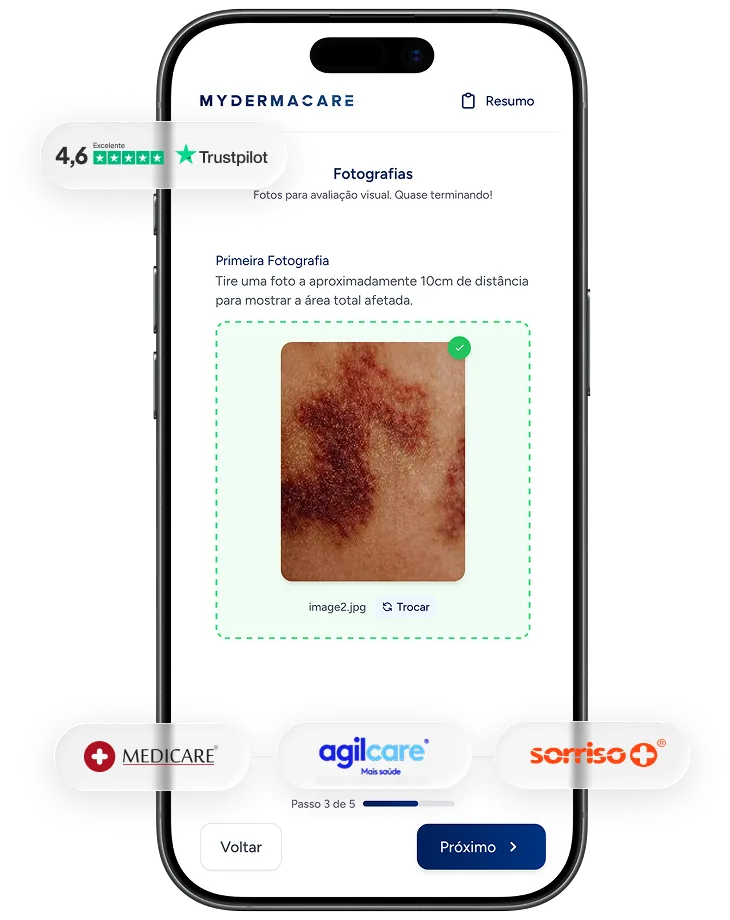
The diagnosis is clinical — by the typical appearance and distribution. In an online consultation, the dermatologist evaluates photographs of affected areas in good lighting and a questionnaire on evolution and context.
In doubtful cases, Wood’s light examination or a direct mycological examination — performed in person, may be useful.
Options for treatment
Pitiriasis versicolor responds well to topical treatment. Total skin colour recovery is gradual — pigment change may persist for weeks after treatment is completed.
Topical application
Antifungal formulations applied to the skin, indicated by the dermatologist. Treatment basis in most cases.
systemic treatment
Reserved for extensive or recurrent conditions, defined by the dermatologist with clinical follow-up.
Preventing recurrences
In patients with frequent recurrences, a maintenance plan — adjusted by the dermatologist — reduces the risk. Aired clothing, dry the skin well after physical activity and other care also make a difference.
Talk to a dermatologist about pityriasis versicolor
No months-long wait for an in-person appointment. Each case reaches the dermatologist already prepared with photographs, history and questionnaire answers. Choose a report in under 24h or a booked video consultation.
Start consultationFrequently asked questions
Is it contagious?
Pitiriasis versicolor is not classically contagious — the fungus already inhabits everyone’s skin. Some factors make some people more susceptible to proliferation, which explains that it is personal.
Why don't the stains go back to normal colour?
After treatment, stains can maintain colour changes for weeks — the fungus has already been eliminated, but pigmentation takes time to normalize. The prudent sun exposure helps to standardize the colour.
Is online consultation for pityriasis versicolor?
Yeah. The appearance is generally recognizable by photography, and the dermatologist defines the plan — initial treatment and maintenance. Doubtful cases may require further face-to-face evaluation.
Will you come back after being treated?
Often yes. It tends to recur — especially in hot climates and in people with intense perspiration. A maintenance plan reduces that risk.
Treat pityriasis versicolor quickly
Send photographs in good lighting. A dermatologist evaluates and sends a treatment plan — an average of 24 hours.
- From 60€
- Quick diagnostic:
- Maintenance plan