
Psoriasis
Chronic autoimmune inflammatory disease of the skin, with typical plaques and progression by outbreaks. It benefits from a continued treatment and follow-up plan by a dermatologist.
What is psoriasis
Psoriasis is a chronic immune-based inflammatory disease that primarily affects the skin. It is characterized by scaly-eritematic plaques, well delimited, often with itch. It evolves into outbreaks and alternates periods of improvement with periods of worsening.
It affects about 2-3% of the world's population. It may appear at any age, but peaks of onset are between 15-25 years and between 50-60 years. It is not contagious and is not an allergy — it is a dysfunction of the immune system that manifests itself in the skin.
Signs and symptoms
The manifestations vary with type and gravity, but the most recognisable signs are:
- Well-defined red plates, covered by silver-white scales.
- Typical locations — elbows, knees, scalp, lumbar region.
- Itch — not always present, but often.
- Nail changes — punctiform depressions, thickening, detachment (onycholysis).
- Painful fissures in flexion zones or thick plates.
- Sensation of pruned skin, especially in the most affected areas.
- Auspitz sign — small bleeding points when removing scales (should not be done on purpose).
Types of psoriasis
Psoriasis may present in several patterns, with distinct implications for treatment:
- Plaque psoriasis (vulgar) — the most common pattern with well-defined plaques.
- Psoriasis gutata — small gout-shaped lesions, often after a throat infection.
- Inverse psoriasis — in fold zones (axillae, groins, under the breast), without evident scales.
- Pustular psoriasis — lesions with sterile pustules (localised or generalized).
- Erythrodermal psoriasis — involvement of almost all body surface (rare, requires urgent evaluation).
- Nail psoriasis — predominant or exclusive nail involvement.
- Psoriasis of the scalp — very common, with plaques covered with thick scales.
Causes
Psoriasis is a multifactorial disease in which genetic, immune and environmental factors interact:
- Genetic predisposition — various associated genes; family history in about 30-40% of cases.
- Immune dysfunction — exaggerated inflammatory response mediated by cells T and specific cytokines.
- Accelerated turnover of skin cells — epidermal renewal that usually takes 28 days is done in 3-5 days.
- Environmental factors that trigger or aggravate outbreaks in those with predisposition.
Frequent triggers
Not all patients recognise clear triggers, but some are well established:
- Infections — mainly streptococcal pharyngitis (associated with gutata form).
- Intense emotional stress.
- Certain medicines — to be discussed with the doctor before starting or stopping any therapy.
- Skin trauma (Koebner’s phenomenon — lesions appear in areas of wound or irritation).
- Consumption of alcohol and smoking:
- Cold, dry air and lack of controlled sun exposure.
Talk to a dermatologist about your psoriasis
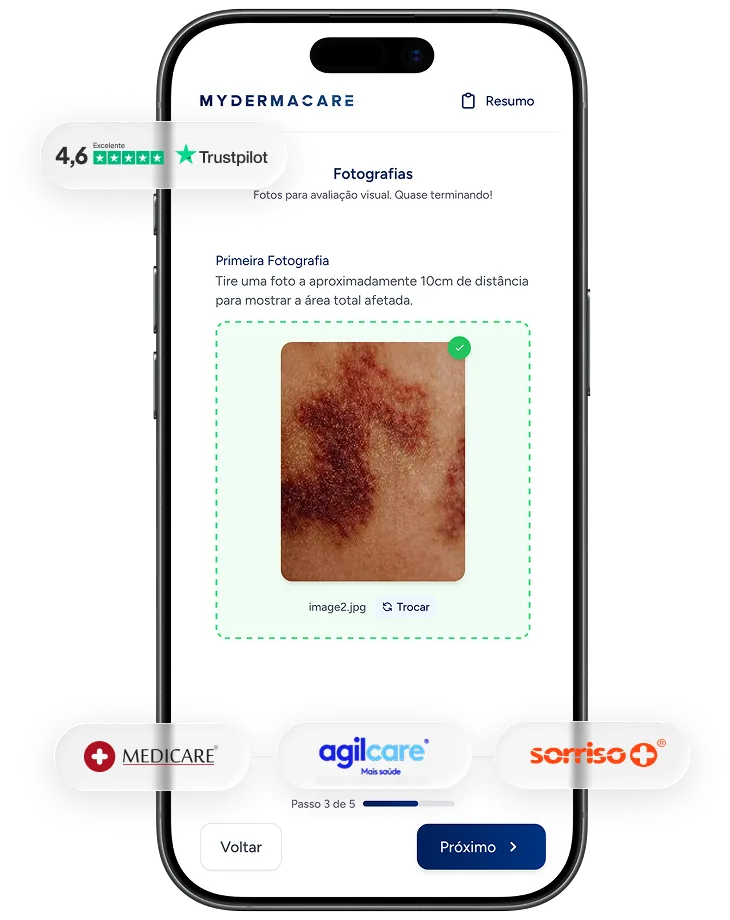
No months-long wait for an in-person appointment. Each case reaches the dermatologist already prepared with photographs, history and questionnaire answers. Choose a report in under 24h or a booked video consultation.
Start consultationDiagnosis
The diagnosis is clinical, made by the evaluation of lesions, typical distribution and family history. No routine tests required.
In an online consultation, the dermatologist analyzes photographs of the affected areas and a questionnaire on evolution, treatments already experienced and family history. With this information classifies the type, evaluates the extension and defines a custom plan.
In doubtful situations or when it is necessary to distinguish from other dermatoses, a skin biopsy — which requires face - to - face evaluation — may be recommended.
Options for treatment
Psoriasis is chronic but responds well to treatment. The aim is to reduce the extent of injuries, relieve symptoms and maintain long periods of remission. The strategy depends on severity, affected locations and impact on the patient's life.
Topical application
Applied directly to the lesions is the basis for mild to moderate forms. The choice, rotation and adjustments over time are made by the dermatologist, with continued follow-up.
Actinotherapy
Therapeutic use of controlled exposure to ultraviolet radiation in a medical environment. Indicated in moderate to extensive frames, it is defined case by case.
systemic treatment
Reserved for moderate to severe or resistant to previous treatments. It is defined by the dermatologist with regular clinical and analytical follow-up.
Regardless of the strategy, supportive care — daily hydration, trigger management, comorbidity control — is part of the plan.
Beyond the skin
Psoriasis is a systemic disease, not only cutaneous. Some patients develop other manifestations that should be evaluated and monitored:
- Psoriatic arthritis — joint pain, stiffness and inflammation; may precede or accompany skin lesions.
- Increased cardiovascular risk — to be discussed with the family doctor.
- Association with metabolic syndrome, obesity and insulin resistance.
- Significant psychological impact — anxiety and depression are common and should be addressed.
Frequently asked questions
Is psoriasis curable?
There's no definitive cure. It's a chronic disease. But proper treatment allows you to control the lesions and maintain long periods of remission. Many patients can live virtually without visible injuries with the right plan.
Is it contagious?
Nope. Psoriasis is not an infection, it is not transmitted by contact, object sharing or any other form. It's a chronic immune-based inflammatory disease.
Does food influence?
A balanced diet, weight control and alcohol limitation help in global control. There is no "anti-psoriasis diet" with strong evidence, but healthy lifestyles reduce triggers and improve response to treatment.
Is the online dermatology consultation for psoriasis?
Yeah. Psoriasis is well assessed by photographs and clinical questionnaire. The dermatologist classifies the type, evaluates the extension and defines a personalized plan. It is especially useful for continuous follow-up between face-to-face consultations when they exist.
Can injuries appear in other areas after treatment?
Yeah. Psoriasis may appear in new locations, especially in areas of cutaneous trauma (Koebner's phenomenon). A continued plan, and not just the punctual treatment of the outbreak, is what provides the best long-term results.
Control psoriasis with continued follow-up
Clinical questionnaire, photographs and a dermatologist responds within the time frame of the chosen plan. Ideal for plan review or follow-up between outbreaks.
- From 60€
- Report on average within 24 working hours
- Ongoing follow-up