
Actinic keratosis
Skin lesions resulting from cumulative lifetime sun exposure. They are considered precancerous and benefit from dermatological evaluation and surveillance.
What is actinic keratosis
Actinic keratosis is a skin lesion resulting from cumulative lifetime sun exposure. It typically appears in chronically exposed areas — face, ears, scalp (in whom there is less hair), back of hands and forearms.
It is considered a precancerous lesion: a small proportion may progress over time to squamous cell carcinoma. Therefore, even lesions that appear harmless should be evaluated by a dermatologist, treated when indicated and monitored over time.
Appearance
- Small rough plates to the touch, with dry peeling.
- Variable colour — pink, red or brown skin.
- Sensation of "waste" when you pass your finger — you often sit before you see it.
- Typical location — face (testa, nose, ears, lower lip), scalp, back of hands and forearms.
- They can be isolated or appear in groups in areas with marked photoaging signs.
- Usually painless; some may become sensitive or hurt clothing.
CAUSES AND RISK FACTORS
- Cumulative lifetime solar exposure — the determining factor.
- Clear phototypes (I and II).
- Occupations and outdoor activities (agriculture, construction, sports).
- Age — more frequent after 50 years.
- History of intense sunburns in childhood.
- Immunosuppression (e.g. after organ transplantation).
Diagnosis
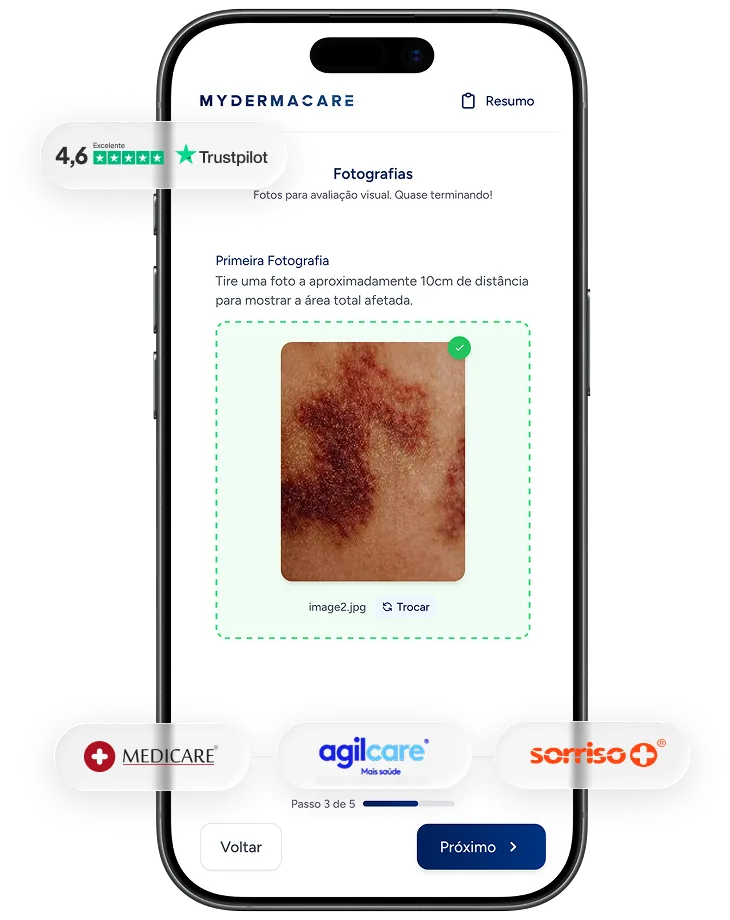
The diagnosis is clinical. In an online consultation, the dermatologist evaluates photographs of the lesions and a questionnaire on location, evolution and history of sun exposure. A person with keratosis often has multiple injuries at the same time.
In lesions with atypical appearance, very thick, painful, rapidly growing or ulcerated, the dermatologist indicates face - to - face evaluation with dermatoscopy and eventual biopsy — an essential step to exclude carcinoma.
Options for treatment
Treatment is indicated to reduce the risk of progression. The choice depends on the number, extent and location of the lesions.
Topical application
Formulations applied at home, indicated by the dermatologist, useful when there are several lesions in an extensive area ("cancer field").
Dermatological procedures
There are several procedures performed in the office (creotherapy and others) especially useful for isolated or selected lesions. Done in person.
Continued surveillance
Regardless of the initial treatment, long-term follow-up is essential — new lesions may appear and others may develop. It's a long-term surveillance condition.
Talk to a dermatologist about your actinic keratosis
No months-long wait for an in-person appointment. Each case reaches the dermatologist already prepared with photographs, history and questionnaire answers. Choose a report in under 24h or a booked video consultation.
Start consultationPrevention
- Daily sun protection — broad spectrum photoprotector, high factor, applied with abundance.
- Reinforced protection every 2 hours on display.
- Wide-shade hat, sunglasses, protective clothing.
- Avoid hours of greater solar intensity.
- Regular assessment by a dermatologist if there are lesions or risk factors.
- Self-assessment — report new lesions or changes in existing lesions.
Frequently asked questions
Is it cancer?
Nope. Actinic keratosis is a precancerous lesion — not yet a cancer, but a small proportion may progress to squamous cell carcinoma over time. Therefore, evaluating and treating when indicated is important.
Does everyone need to be treated?
Not necessarily. The decision depends on the number, appearance, location and individual risk. The dermatologist discusses the plan with you — in some cases surveillance is sufficient; in others, immediate treatment.
Is online consultation for actinic keratosis?
Yes, in the screening and planning phase. From the appearance and history it is often possible to identify the lesions, plan topical treatment and schedule procedures in face-to-face consultation. Suspicious lesions for carcinoma require face-to-face evaluation with dermatoscopy.
If I removed one, can you come back?
Yes — in the same location or in new locations. Actinic keratose skin usually has diffuse solar damage, with risk of new lesions. So continued surveillance is essential.
Watch actinic keratosis with a dermatologist
Send pictures of the injuries. A dermatologist evaluates and defines a treatment and surveillance plan — without waiting for months.
- From 60€
- Skin screening
- Continued surveillance