
Moles (naevi)
We all have signs. Most are benign and do not require treatment. But some signs should be watched by a dermatologist — early evaluation is the key to safety and tranquility.
What are the signs
The signs — in medical terms, melanocytic nevi — are benign accumulations of melanocytes, the cells that produce pigment in the skin. We all have signs: in adults, the typical number ranges from 10 to 40, and they continue to appear throughout life, especially in the first decades.
Most signs are totally benign and do not require any treatment. A very small minority is at risk of evolution — hence the importance of regular surveillance and evaluation of signs that change, are different from others or have symptoms.
Signal Types
- Congenital snows — present at birth or in the first months of life.
- Acquired snows — they appear throughout life, especially until the age of 30.
- Junctional snows — flat, brown colour uniform.
- Compound snow — slightly high, brown.
- Intradermal snows — higher, skin colour or light brown, typical of adults.
- Atypical (dysplastic) snows — irregular edges or variable colour; require vigilance.
- Blue snow, halo snow — specific variants with particular aspects.
Alarm signals — the ABCDE method
The ABCDE rule helps identify signs that deserve assessment by a dermatologist:
- **Symmetry — one half of the signal is not the same as the other.
- **B**ord — irregular, poorly delimited, with inputs and outputs.
- **C**or — colour variation in the same sign (brown, black, red, blue).
- **D**diameter — usually signals > 6 mm deserve attention, especially if new.
- **E** Evolution — any change in size, colour, shape, symptoms (itch, wound, bleeding) over time.
- "Ugly duckling" — a sign that is clearly different from the others of the same person.
None of these criteria alone means that a signal is worrying — they serve to guide the decision to seek evaluation. All signs with one or more of these criteria should be seen by a dermatologist.
How to watch for signals
- Regular self-examination — once a month, with mirrors or help from someone to less visible areas.
- Photograph individual signals or map the skin — useful for comparing over time.
- Regular assessment by a dermatologist — annual or individual risk.
- Strict sun protection — the main modifiable risk factor.
- Report changes as soon as they are noticed.
- Greater attention factors — people with many signs, family history of melanoma, light phototype, history of intense sunburn.
Diagnosis and evaluation
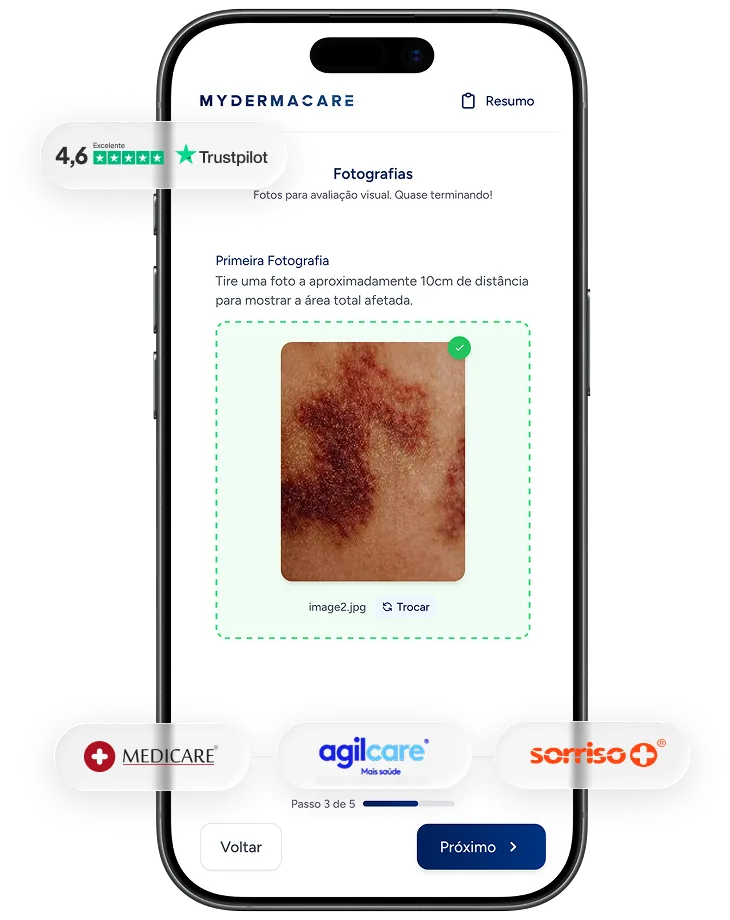
In an online consultation, the dermatologist evaluates photographs of signs he wants to see evaluated — in good lighting, near and at a distance — and a questionnaire on evolution, symptoms and personal and family history. It is a practical way of screening: to get a first expert opinion quickly.
The definitive evaluation of suspicious signs requires dermatoscopy — performed in a face-to-face consultation. If the dermatologist considers that there is an indication, he or she or she will be instructed for this evaluation and, if necessary, for biopsy or excision. This step is always in person.
Talk to a dermatologist about your signs
No months-long wait for an in-person appointment. Each case reaches the dermatologist already prepared with photographs, history and questionnaire answers. Choose a report in under 24h or a booked video consultation.
Start consultationFrequently asked questions
Is it safe to wait months to evaluate a signal that has changed?
Signs that have changed appearance, colour, size or symptoms should be evaluated as soon as possible. Online consultation allows rapid screening and, if necessary, directs immediately to the next face-to-face step.
Does the online consultation serve to evaluate signs?
Yeah, for triage and planning. Due to the aspect and evolution reported, the dermatologist can often provide clinical guidance. Dermoscopy — necessary for many definitive diagnoses — requires face - to - face evaluation. The dermatologist clearly indicates when to go.
Should I take out all the irregular signals just in case?
Nope. Preventive removal without clinical indication is not the recommended strategy. The goal is to watch and intervene when there is clear indication — avoiding unnecessary scarring.
How should I photograph a signal for the appointment?
In good natural lighting, with a close photo (with the signal filling much of the frame) and another medium distance showing the location. Ideally also a photo with scaling object (e.g. ruler next door).
Evaluate your signs with a dermatologist
Send photographs in good lighting. A dermatologist gives a first opinion and guides the next step — an average of 24 hours useful.
- From 60€
- Rapid screening
- Clear guidance