
Tinea capitis
Fungal infection of the scalp, especially in school-aged children. Recognized by broken hair, peeling and areas with hair failure.
What is tinea capitis
Tinea capitis is an infection of the scalp by dermatophyte fungi. It mainly affects children of school age and is highly contagious. Untreated, it can lead to permanent scarring — so it is important to evaluate early.
It is one of the causes of hair loss in children that always justifies assessment by a dermatologist.
Signs and symptoms
- Circular areas on the scalp with shorter hair, broken or absent.
- Flaking (may simulate dandruff).
- Mild to moderate itch.
- Papules or pustules in some more inflammatory forms.
- In the most severe forms — kerion: inflammatory, painful mass, with pus, which can leave scarring.
- Increased cervical ganglia is common.
contagion
The transmission is made by direct contact with infected persons or animals, or by shared objects — combs, brushes, hats, towels. It spreads easily in families, schools and kindergartens. It is essential not to share these objects and simultaneously treat contacts with symptoms.
Diagnosis
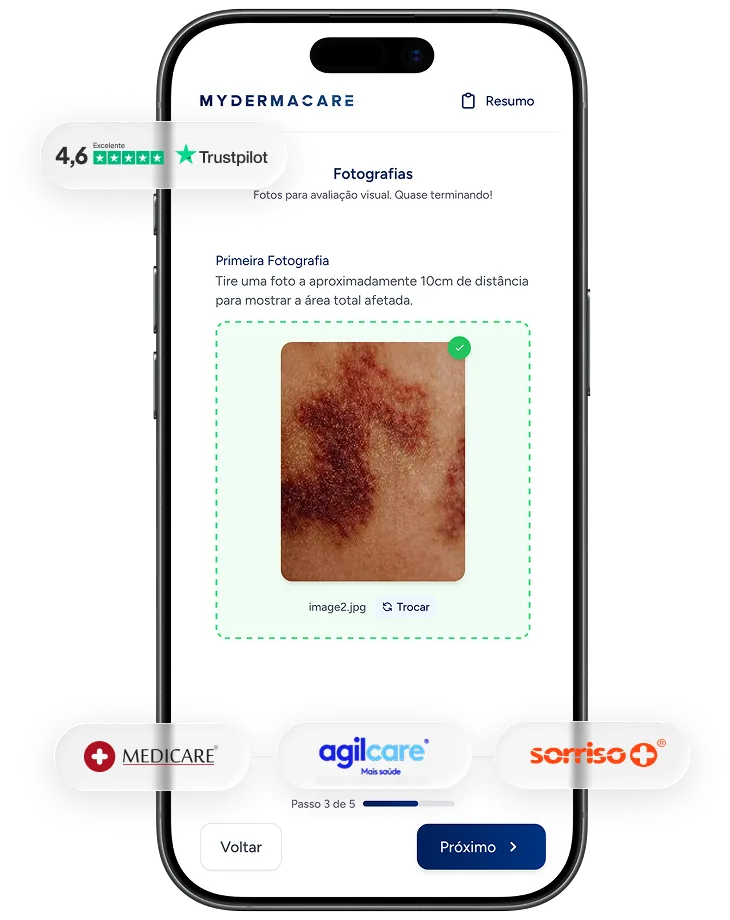
The diagnosis is clinical, supported by complementary exams. In an online consultation, the dermatologist evaluates photographs of the affected areas and a questionnaire on onset, exposure and symptoms.
Whenever possible, direct and cultural mycological examination — done in person consultation — confirms the diagnosis and guides the treatment. This step is important before prolonged systemic treatment.
Options for treatment
The topical treatment alone is usually not enough in tinea capitis — infection involves deep hair. Systemic treatment is often necessary.
systemic treatment
Defined by the dermatologist, with clinical follow-up and adjustment according to the response. It requires adherence to the complete scheme.
Complementary topical treatment
Specific shampoo reduces fungal load and risk of transmission to third parties. Used in parallel with systemic treatment.
Family/school control measures
Assessment of close contacts with symptoms. Don't share combs, brushes, hats, towels. Strict hygiene of objects and environment.
Talk to a dermatologist about tinea capitis
No months-long wait for an in-person appointment. Each case reaches the dermatologist already prepared with photographs, history and questionnaire answers. Choose a report in under 24h or a booked video consultation.
Start consultationFrequently asked questions
Can the child go to school?
You should start treatment before returning. With appropriate treatment, return to school is usually authorised in the short term. The dermatologist or pediatrician confirms it.
Is the hair born again?
Yes, in most cases with appropriate treatment. In the forms with Querion or later treated, there may be residual alopecia.
Is online consultation for tinea capitis?
Yeah, for initial evaluation and guidance. Mycological examination and systemic treatment require additional face - to - face consultation — the dermatologist indicates the next step.
If the dermatologist considers it clinically justified, is prescription issued?
Yeah. When the dermatologist considers clinically justified in the context of his case, electronic prescription may be issued together with the report. The decision to prescribe depends on the clinical evaluation.
Assess for tinea capitis quickly
Send photos of the affected areas. A dermatologist evaluates and proposes the plan — an average of 24 hours useful.
- From 60€
- Ideal for pediatrics
- Quick diagnostic: